


There is so much anxiety and confusion that runners face when it comes to carb loading before a marathon. With a lot of misinformation out there, I hear a lot of concerns from runners. Concerns like:
- “Will I feel heavy?”
- “What if I get bloated?”
- “Am I eating the right things?”
- “I’m afraid of being heavy on race day.”
All of these are valid concerns. This blog post will address all of them.
Carb loading for a marathon can be a very different time in your running journey. You’ve been training for 16 weeks or more. You’ve fuelled your training, but what do you do in the days before the big race? You may have heard the term ‘carb loading’ but aren’t sure what it means. You’ve heard runners say it can help you avoid hitting the wall. But other runners have told you it made them feel horrendous.
Let’s get into it and bust some of those myths.
Why is Carb Loading for Marathon Runners So Important?
Carbohydrates are our body’s main fuel source. They provide energy, especially for endurance running. Our body uses two main types of fuel: carbohydrates and fats.
Fats are a slow-burning energy source. But fats cannot provide energy fast enough for a marathon. That’s when we rely on our carbohydrate stores. Carbohydrates are broken down into glucose and stored as glycogen in our muscles and liver.
What we want to do during the carb-loading phase is make sure our stores are at their max. Think of it like filling your car with petrol. We want to make sure our glycogen stores are full and ready to go.This reservoir of energy helps to prevent hitting the wall on race day. Even when our carb stores are full, we only have about 90 to 120 minutes of energy stored. That’s why we top up our stores during the race. By maxing out our stores beforehand, we have less chance of running out of fuel. Research has also shown it can improve a marathon finish time by about 4%.
The Crucial “When”: Practising Your Marathon Fuelling Strategy
A lot of the misinformation around marathon fuelling comes from the idea that carb loading is something you do the night before. You’re told to just eat a massive bowl of pasta before going to bed.
Actually, the process of carb loading takes place over several weeks. You will learn to do it in your long training runs. The main carb loading for a marathon is done in the 36 to 48 hours before race day. So we are not talking about just the night before.The “nothing new on race day” rule includes race week. That is why you should have already practiced your carb load. Practicing helps you avoid GI issues on race day.
The “What”: How to Carb Load for a Marathon with The Athlete’s Plate
When you hear about marathon carb loading, you may hear figures like “10 to 12 grams of carbohydrates per kilogram of body weight.” This is the true, recommended amount. The research shows it is beneficial.
However, not everyone wants to be counting their carbohydrates. For some, counting can be stressful. We can use a visual way to help us with this. Race week is busy enough. The last thing you want to be doing is counting every morsel of food that goes into your body.
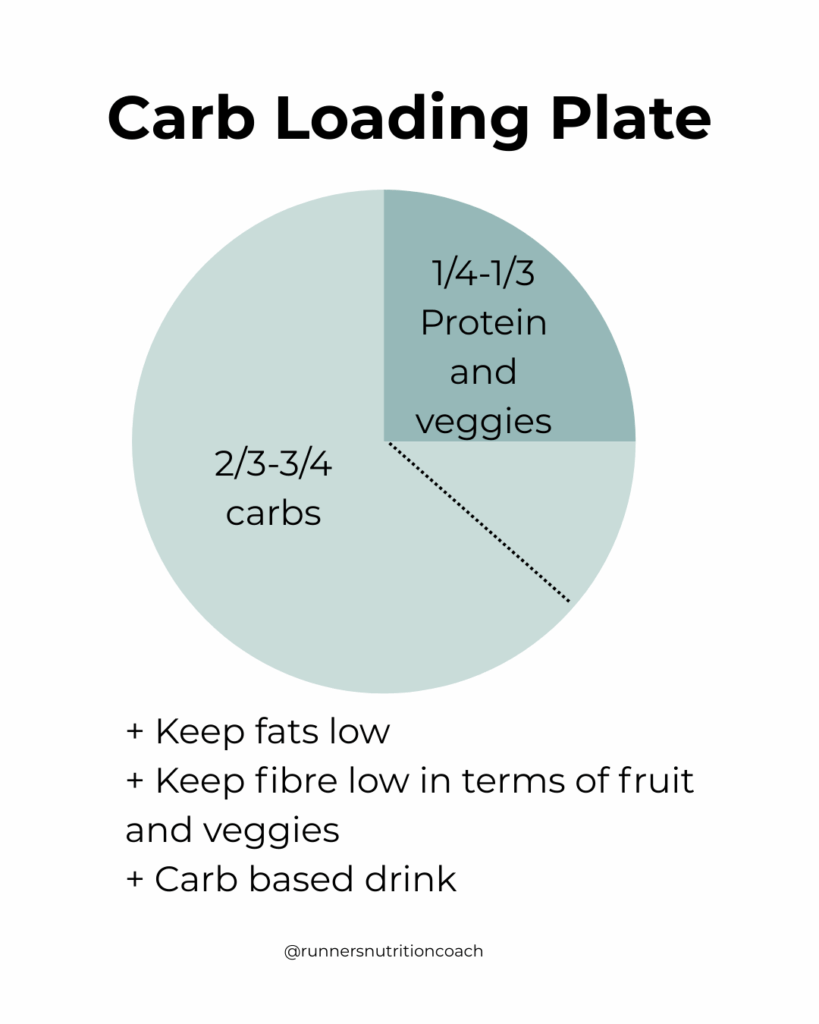
We can do this in a simple way. Just look at your plate. I want you to think of 50% to 75% of your plate being carbohydrate-rich foods. The rest is made up of:
- Protein
- A little bit of healthy fats
- Fruit and vegetables (but not too many)
The goal is that your overall diet should be 85% to 95% carbohydrates during this period.
Focus on simple carbohydrates during your marathon carb loading. Simple carbohydrates are easy for our bodies to break down. This is why we want the simple carbohydrates:
- Orange juice
- White pasta
- White rice
- Sweets like Haribo
Carb Loading and the Psychological Element
This is a concern I hear about most from runners. They are worried about body weight. They don’t want to gain weight going into a marathon. This can be a very sensitive topic. I completely get it.
Firstly, carb loading doesn’t mean eating everything in sight. It is a strategic increase in carbohydrates. It is not permission to eat as much as you like.
To deal with GI issues, we want to minimise our fibre and fat intake. Both fat and fibre will slow digestion. When we are carb loading before a marathon, we want our body to focus on getting the carbohydrates in. Keeping fibre and fat to a minimum helps reduce bloating.
It is also common to feel food anxiety. You might feel heavier or bloated. This is perfectly normal. A little bit of weight gain is what we would expect. This is the fuel your body is going to use on race day.
You are going to eat more sugary foods. But we do want to minimise high-fat foods. A massive, greasy pizza the night before is probably not going to make you feel great. Avoid creamy sauces and go for tomato-based sauces.
Hydration is Key to Successful Carb Loading
We cannot ignore hydration. When our body stores carbohydrates as glycogen, it also stores three to four water molecules with each gram. This is where the water weight comes from that we sometimes see on the scales. It is perfectly normal.
That hydration is also very important for your body on race day. You will be sweating for a long time. Having excess fluid in our body beforehand can be very beneficial.So, make sure you stay hydrated while carb loading. You may need to drink a little more water than normal. Consuming carbohydrate sports drinks can also be a great way to get hydration and extra carbohydrates at the same time.
Putting It All Together: Your 3-Day Race Week Plan
Three Days Before the Race
- Increase your carbohydrates. Aim for 50% to 75% of your plate to be carbs.
- Start to cut back on fibre to aid digestion.
Two Days Before
- Continue the high carb intake.
- Start thinking about packing your race bag. Include some of those familiar foods you might be eating.
The Night Before
- You may want to have a slightly smaller meal. This is a strategy you should have practiced in training.
- Some people find a massive meal the night before can sit in their stomach. It can make them feel heavy and sluggish.
- Focus on eating until you feel satisfied.
Race Morning
- The carb load does not stop!
- Have a high-carb breakfast two to three hours before the start of the event.
- Bagels or porridge are great. If porridge upsets your stomach, rice pudding is an excellent alternative. It is packed with carbohydrates but without the fibre.
FAQ: Your Top Questions About Marathon Carb Loading Answered
Should you carb load the night before a race? Yes, but you should not leave your carb load until the night before. You should have started 36 to 48 hours before the event.
What foods should I avoid? Avoid high-fibre and very high-fat foods. Also, avoid anything you are not familiar with. Stick to foods that are part of your regular diet but in larger quantities.
Is rice or pasta better for carb loading? Both are great. Pick what you enjoy and what works for your gut. Focus on simple carbs like white rice and white pasta.
How much protein do I need? You don’t want to neglect protein. But it can make you feel full and slow digestion. So, you may eat slightly less than normal to make space for more carbs. You should still aim for around 20g with your meals but don’t stress if you don’t hit this for these few days.
What about energy gels? Energy gels are for use during the marathon. You can also use one or two during your carb-load period to help you hit your carbohydrate goals. Taking a gel during your taper runs will also train your gut for race day.
Conclusion
Carb loading before a marathon is scientifically proven to be beneficial. It can help decrease your marathon time by around 4%. While the general guidance is to eat 10 to 12 grams of carbohydrates per kilogram of body weight, it is okay to use your plate as a guide. Aim for 50% to 75% of your plate to be carbs. Remember, carb loading for a marathon is a strategy that should be practiced. Don’t leave it to race week.
Ready to take control of your marathon fuelling? Download my free cheat sheets guide to carb-loading for a quick checklist of everything just discussed. For personalised help with your fuelling, check out my coaching program.
Additional Resources
For more on the science of carb-loading here is a journal article that dives into it
For more general resources Precision Hydration have a great knowledge hub

View comments
+ Leave a comment